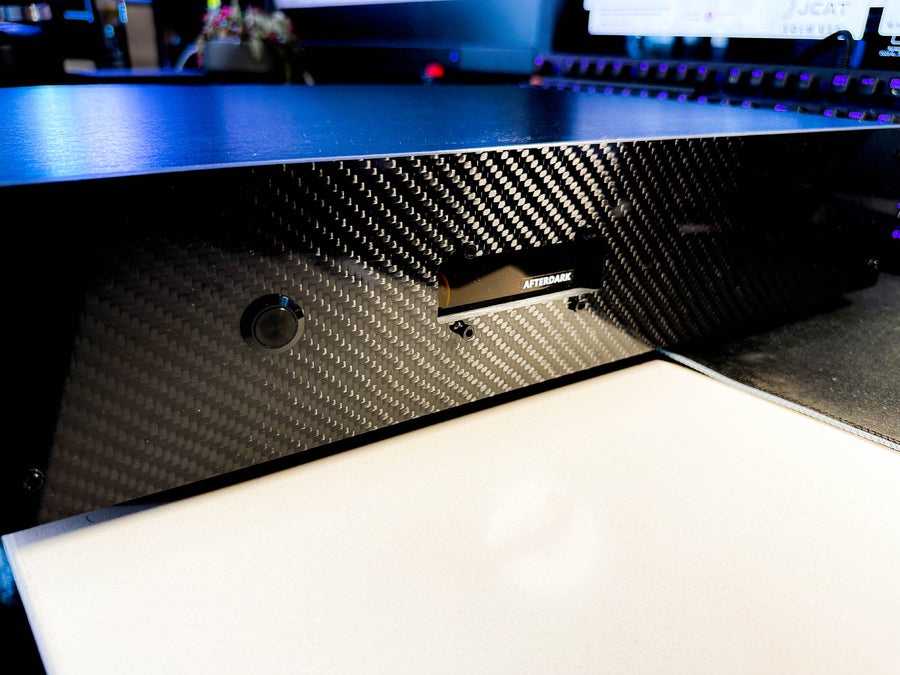
New Diretta Products is coming soon



$2,713.00
The new development of Project ClayX Karmann Diretta DDS Mode 3 Player


What is the idea of Diretta DDS Mode 3 Player?
The one box solution to build in both Diretta Host and Diretta Target to support native DDS
Avoid Diretta setup problem on hardware and complex software or coding on instatallaton.
Plug and Play solution for Audiophiles
The Diretta Host will direct connect to Diretta Target with one ethernet cable for Diretta DDS performance optimisation.
One isolated WAN port for internet (SFP or RJ45 port)
All software is licensed and preinstalled, tuned with AfterDark. Tweaks
Diretta DDS will work plug and play for all USB DAC
Avoid hardware constraints with limited MTU=1500 instead of Max MTU=16128
All modules with optimised with Giesemann Clock Sync Module (GCSM) with OCXO.
Passive cooling for both Diretta Host and Diretta Target,
One box solution to provide cascade isolation principle: True isolation is built in layers to completely decouple your sensitive DAC from the house network.
Main Network -> SFP optical -> Diretta Host (Isolate Host from the home network)
Diretta Host -> Dedicated Ethernet Cable -> Diretta Target (Isolated via point to point link and the protocol stack)
What is Diretta DDS?
Audio Transmission protocol that bypasses the IP (Layer 3) and Transport (Layer 4) network layers, sending audio via direct Layer 2 Ethernet frames.
This lowers CPU load and electrical noise on the Target device.
DDS Mode 3 is supported

The Three-Tier Architecture: Roon + Diretta
This setup will evolves Roon's recommended two-box setup into an ultimate, three-tier system that provides multiple, compounding layers of isolation.
Tier 1: Roon Core: Roon or HQplayer server runs on a dedicated machine, placed far away from your listening room. It does all the heavy processing, and its electrical noise is kept isolated from your audio system. SFP connection is recommended for further optical isolation.
Tier 2: Diretta Host: The first isolated AfterDark. Karmann Module will as the Diretta Host. It connects to your main network switch and, receives the audio stream data from the Roon Core or HQplayer, and then transmits it in tiny, precisely timed segments, eliminating the bursty nature of the original stream.
Tier 3: Diretta Target: The second isolated AfterDark. NS1 Mini will act as the Diretta Target, connects only to the AfterDark. Karmann Module via a short Ethernet cable, creating a point-to-point, galvanically isolated link. It receives the audio from the Host and connects to your DAC or DDC via USB.
The Embedded Diretta will be installed on AfterDark. NS1 to have core isolation. Only Diretta application is running.
The Diretta DDS Mode 3 Player will combine Tier 2 and Tier 3 into one chassis.
The combination of the physical galvanic isolation from the point-to-point Ethernet link and the processing noise elimination from the Diretta protocol creates a profoundly clean signal path to your DAC—one that can leapfrog solutions costing many thousands of dollars.
Jumbo Frames Optimization
High Bendwidth efficiency at MTU 16128.
Optimial DDS will requires 16K on both NIC on Diretta Host and Target.
The AfterDark. NS1 may be the only target devices, tested to support native MTU at 16128 without using the external USB to Lan module.

Diretta Target MTU=16128

The Diretta Host NIC with Jumbo Frame MTU=16128
Extreme Tuning on Network Speeds
The objective is very similar to EtherREGEN Port A which reducing the link speed form the 1Gbps to 100Mps on the dedicated Diretta Direct Link (DDL) a short green lan cable is preset at 100Mps speed from Diretta Host and Diretta Target) can improve sound quality.
Drastically Lower Carrier Frequencies: Standard Gigabit Ethernet operates at a high-frequency carrier signal of 62.5 MHz (using complex multi-level encoding). Dropping down to 100 Mbps lowers this to 31.25 MHz.This massive reduction in operating frequency significantly lowers the radio frequency (RFI) emissions generated inside the chassis and along the cable.
Reduced Processing Overhead on the Target: High-bandwidth networks force the network interface card (NIC) and CPU to handle data packets at a rapid, aggressive cadence. By capping the link speed to match the actual demands of standard audio data, you drastically reduce the sheer volume of network interrupts the Target's operating system must process.
Synergy with Diretta's Core Philosophy: The entire goal of the Diretta protocol is to eliminate bursty processing and stabilize current draw.
Extreme Tuning on CPU core isolation on Diretta Host and Target
The Diretta DDS Mode 3 Player will tweaks with CPU isolation on Diretta Host Program and Target will utilised with single core isolation for receiving the digital data from host.

Diretta Direct Link cable (green) and SFP cable (orange)
Extreme Traffic isolation and time determinism with "Direct Link"
The "Diretta Direct Link" shows in cable in green, introduced to provide direct point to point connection between the Diretta Host and the Target
The Diretta recognizes that fluctuations in the endpoint's processing load generate low-frequency electrical noise that can evade a DAC's internal filtering (as defined by its Power Supply Rejection Ratio, or PSRR) and subtly degrade its analog performance.
To combat this, Diretta employs its "Host-Target" model, where the Host sends data in a continuous, synchronized stream of small, evenly spaced packets. This "averages" the processing load on the Target device, stabilizing its current draw and minimizing the generation of this pernicious electrical noise.
The "Diretta Direct Link" ensure the connection to you audio endpoint is predictable, the target receives only the audio data, exactly when the host sends it, without any risk of collision on network switch.
New Giesemann Clock Sync Module MKII

All the Diretta modules on Host and Target, with total 5 clock signals will benefit from the 10M Master Clock with lowest phase noise when compared.
Thanks for developement team on the lastest Giesemann Clock Sync Module (GCSM) MKII. The lastest clock sync chips will generated lowest phase noise signal to the motherboard on both Diretta Host , Diretta Target and High Performance SFP NIC.
The GCSM MKII allows auto recovering on 10M Master Clock signal and ensure smooth music playback. While there is 10M Master Clock not avaliable, it will switch to internal clock, and once 10M Master clock is detected, the clock sync module will utilities the 10M Master clock signal automatically without customer intervention. In conclusion, the music will continue to play even there is sudden drop of 10M Master Clock signal.
Chassis
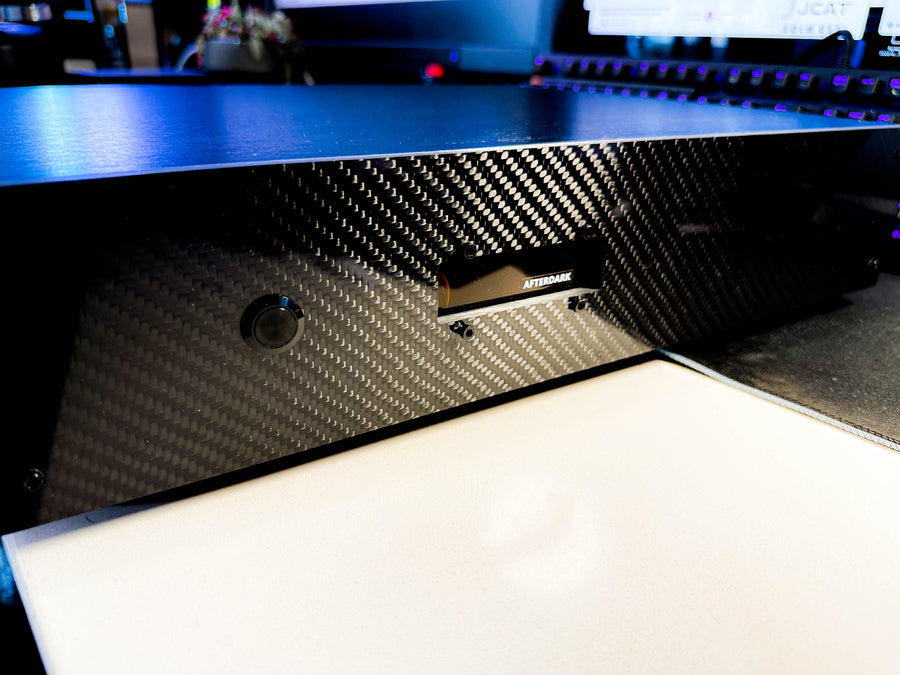
Mansory Edition feature a precision engineered high quality Carbon Fiber baseplate to minimise EMI and high performance vibration dampering system applied across key componenets including Diretta motherboards, capacitor banks, and regulators.

Power Supply
Mansory Edition R8 is a dedicated ultra low noise linear power supply, combining MLytic Mundorf AG Power Capacitors active recification with 188,000uF capacitance, which has exceptional performance on sound tuning. An upgrade Furutech Rhodium IEC with high perfomance LT3041 ultra high PSRR Linear Regulator, ensure clean, stable power delivery. The external LPS will further lower the EMI noise for better music reproduction.

Master Clock
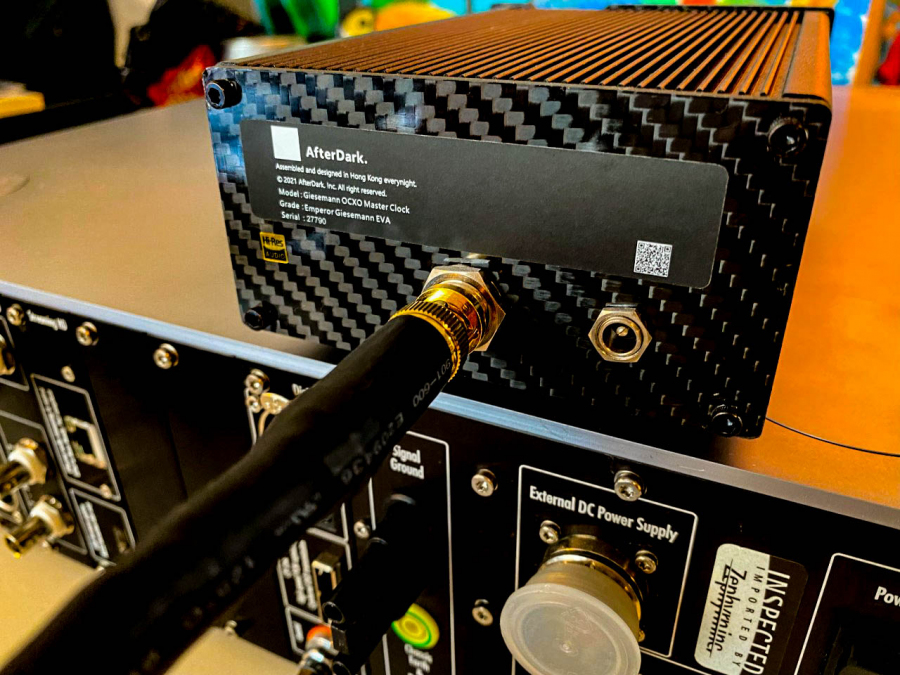
Giesemann OCXO Reference 10M Master Clock can all be used independently and are design to work with existing systems, provide single synchronization with Audiophile network switch, Audiophile DAC, Diretta DDS and HQplayer server. The Giesemann OCXO ensure the accuracy of the master clock prodvide a time domain reference for reading data, its transfer and decoding. As a result, the Master Clock could minimize jitter and ensure the improvement on sounding.
Network
Using a latest Diretta DDS Mode 3, a deeply tuned and customised Diretta mainboards and NIC. It features a next-generation board with both SFP+ optical fiber and RJ45 input, offering a maximum sound quality. Delicated Giesemann Clock Sync Module (GCSM) for generating the clock signal to mainboards, ensure ultra high signal integrity and sound optimaisation in the system.

|
Diretta DDS Mode 3 Player |
|
|
Specifications |
|
|
File Formats |
WAV, AIFF, FLAC, ALAC, AAC, MP3, DSF, DFF |
|
|
Diretta DDS Mode 3 Supported |
|
Master Clock |
10Mhz (Sinewave or Square Wave) at 75 or 50 ohms |
|
Sample Rates |
PCM: Up to 32bit/768KHz |
|
|
DSD: Up to DSD1024 via DoP or via Native DSD to compatible DACs |
|
Connectivity on Diretta Host |
1 X Type-C USB |
|
|
2 x USB 3.2 |
|
|
1 x 2.5G Lan Port (Jumbo Frame Support Up tp 16K) |
|
|
1 x 10G SFP LAN Port or 1 x 10G RJ45 Lan Port (Jumbo Frame Support Up tp 16K) |
|
|
1 x HDMI / 1 x mini Display Port |
|
Connectivity on Diretta Target |
1 x USB 2.0 |
|
|
2 x USB 3.0 |
|
|
1 x 1G Lan Port (Jumbo Frame Support Up tp 16K) |
|
Other |
1 x Storage Expansion Bay (1 x M.2 NVME SSD) |
|
|
1 x 12V DC Power Inlet |
|
|
1 x 4mm Chassis Audio Note Ground Port |
|
Local Music Files |
Internal M2 NVMe SSD |
|
|
NAS Drives/Servers |
|
|
USB Drives** |
|
Software & Integrations |
AfterDark. Diretta ASIO Host Software |
|
|
AfterDark. Diretta ASIO Target Software |
|
Optional: |
Roon (Core and Endpoint modes supported) *License required |
|
|
AfterDark. Diretta Target preset as Roon End Player |
|
Power |
12V DC Rated at 5A |
|
|
R8 Mansory LPS is recommended |
|
Dimensions and Weight |
Dimensions: 310mm x 230mm x 110mm (W x D x H) |
|
|
Weight: 4 Kg |


$143.00
Fidelizer Pro - For Roon Server Download Fidelizer (Trial Version)
$6,415.00
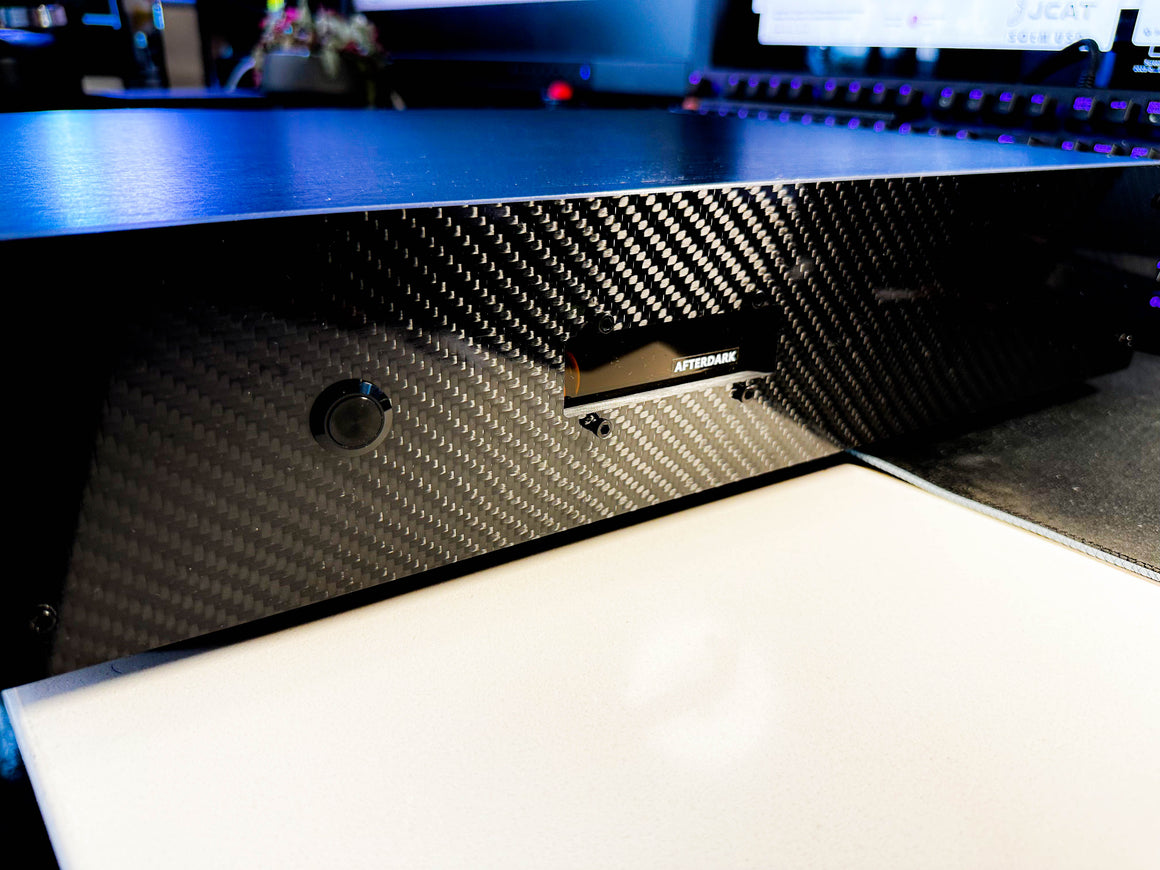
The Giesemann KARMANN Server x HANDHARTILO SERIES - Emperor Double Crown Limited Edition This...
$5,455.00
The Giesemann KARMANN Server - HANDHARTILO Emperor Crown Limited Edition This version is equipped the high performance...